Ikta
-----------------------------------------------------------------

Hello! This is most of what I've come out with Ikta's story so far. One day I wrote this all out randomly to lore dump my friends (at request), it recieves constant revision, and it's extremely convoluted XD
All of my friends think im neurodivergent for talking about this story so much. I'll leave that up to you
-----------------------------------------------------------------

Back
-----------------------------------------------------------------


Firstly, there’s some precedents to set. This reality is completely different from the workings of ours, and it starts with the Divine Hierarchy. At the top is God, they brung into being everything that exists and created the gods. The gods are just below God; the countless gods inhabit countless universes, in which they all strive to acquire a planet through means of neverending holy warfare.
To defeat a god in war, one will kill their opponent, to which their opponent's soul is rebirthed upon another planet to another war, over and over again, until claiming victory. Time is unclear there ... The battle existed ever since God created the gods. It will never end.
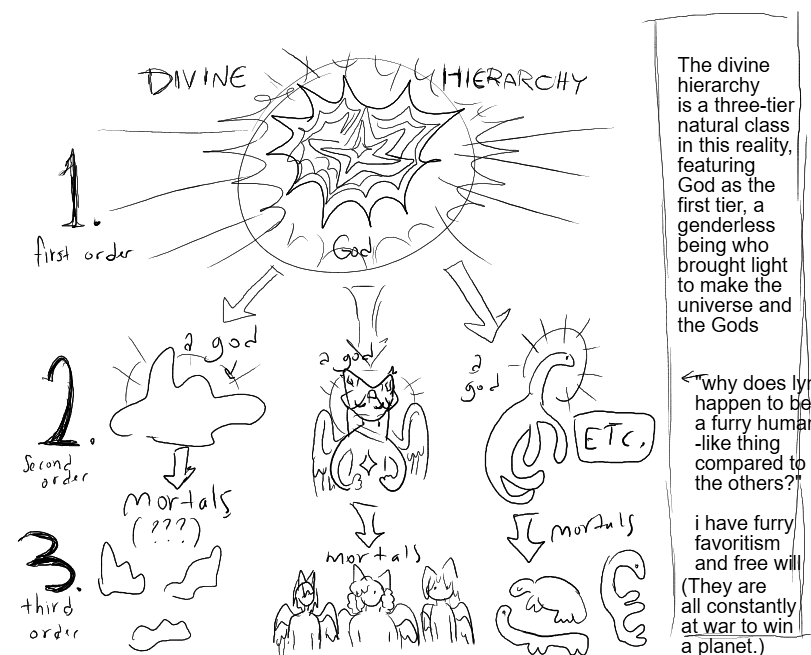
Each planet has millions of gods fighting on it per battle, and the war is won when you have killed every god on that planet. By then, you have well earned the privilege of populating that planet-- When a god has emerged victorious, they use the holy powers given to them by God to create every being on said planet, the beings being of their likeness (although sometimes not completely identical to their god, they will always be made in the god's image.) And from then on, they will watch the planet from afar, from its beginning to its demise.
Gods are made of a soul and pure light, meaning that they don't have the physical capability to experience emotions or pain due to technically not having a brain.
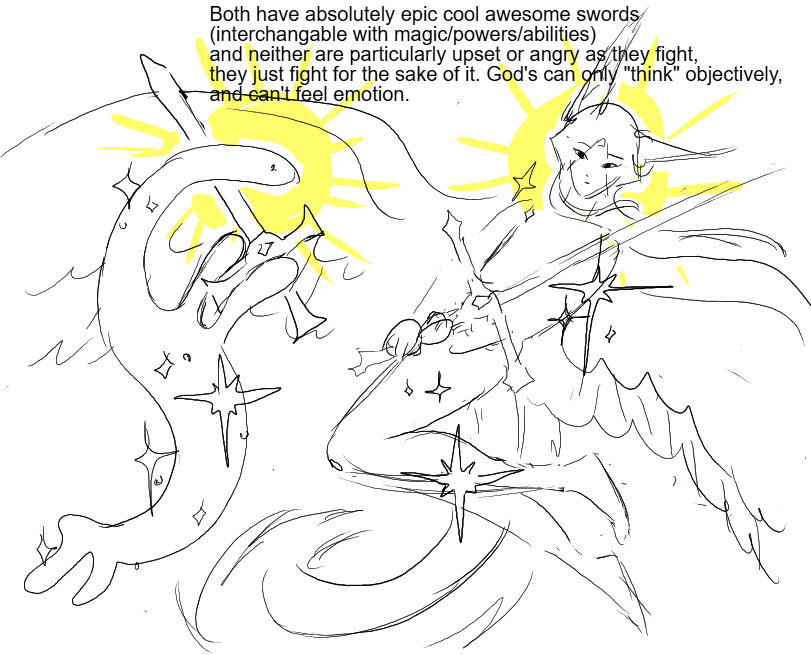
Unless someone is exiled into mortality ...
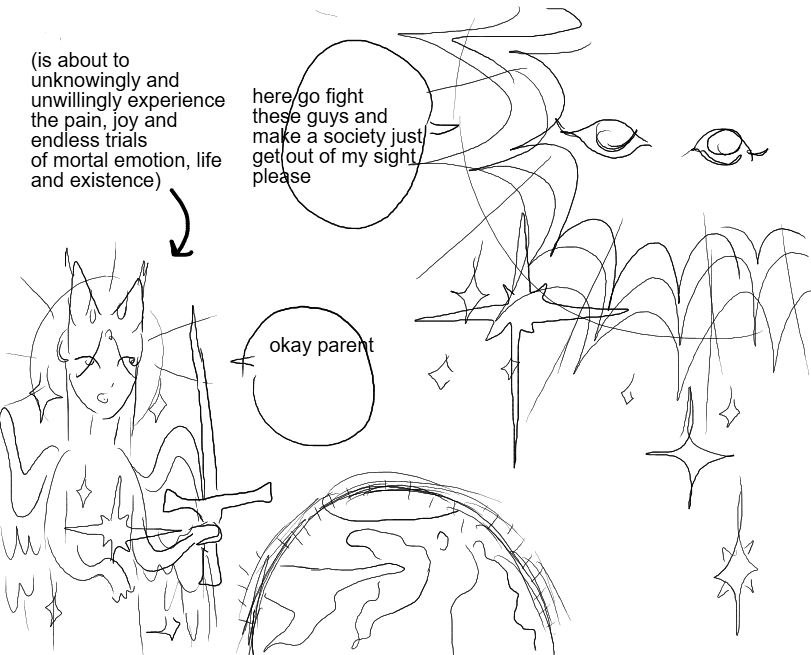
Unless someone is exiled into mortality ... Lynux (pronounced lynn-ucks) is a god who was renowned by God for their skill in the divine wars, allowing themselves to be defeated and rebirthed by other gods for the sake of improvement and battle. But soon Lynux turned their sights to God themselves. With their undefeated, innate power they believed that they had the qualities to defeat god, as a select few had tried before. And they certainly did have the means, but fate favored God, and so Lynux attempted to overthrow God but failed. They failed to kill God, fated to be punished for sin, and in the telepathic language of the divine, God told them this:
"I will send you off to your death as you have sinned the one and greatest sin, I will send you to a warring planet and you will triumph against every god there. For I know you will, because beyond defeat for you is nothingness as of a mortal's fate. You will win. And you will not, cannot die by time, but by your own means."
And so Lynux did, and in their image created the Iktyfs, a species on a planet that would be later named by the Iktyfs, "Ikta", and all the Iktyfs were then created in Lynux’s image. But after they did so, they became a mortal being alongside the people they created.
On an important note, Iktyfs are genderless and only use they/them/theirs to refer to anyone in their language, Iktjkis. The biological situation doesn't have a word, but it's something like intersex. I have used they/them pronouns for Lynux until now, but he actually uses he/they pronouns (mostly he/him from now on.) The reason for this is translation: in Iktjkis, the Iktyf's language on the continent of Ksij-En (I'll get into that later), the word for reffering to another person (they) is "Jeu". But the other Iktyfs referred to him simply as the archaic word for God instead, doubling as a name and a pronoun. That word is now "Ksij", but used to be "Xajij." So the only way to translate this I could think of was to use he/him for Lynux. It also just felt right. So everyone, including Lynux, is agender. (I apologize if things get confusing since everyone uses the same pronoun haha, I try my best.)
Notably, Iktyfs don't have horns like Lynux (see paragraph 3) but all Iktyfs have indentical shared features as a species; wings, a fluffy tail, long ears, and slit pupils. Something fun to note is that Lynux has slit pupils but his eyes are just so extremely dark brown that you can't see them, haha... however if he were to touch grass/go outside in the sun, which he usually doesnt do, you'd see his eyes are dark brown and have a cat-like slit.

Lynux (rough painting)
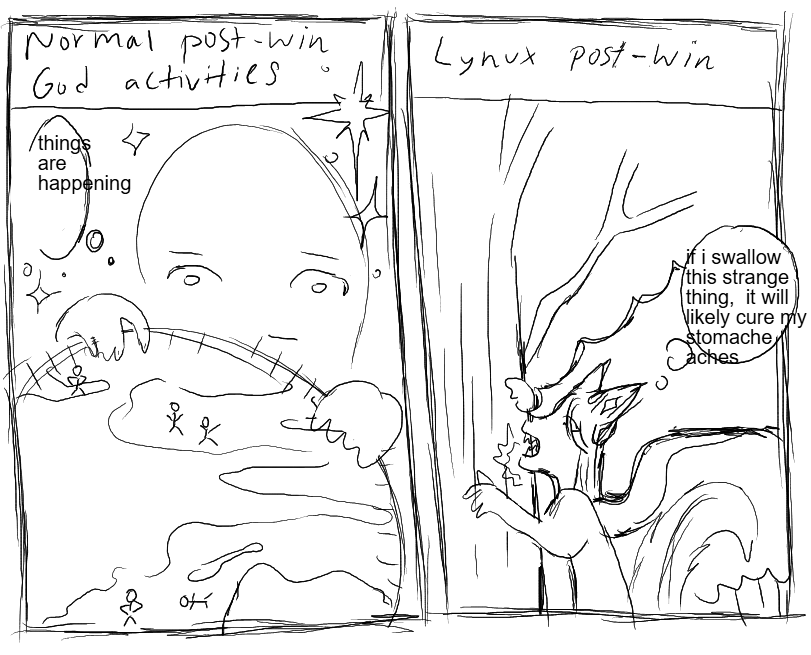
After Lynux created the Iktyfs, he hid. For many, many years he was alone, but it wasn't like he was used to having company. At first, he struggled to understand mortality and almost died. He, 1. Almost drowned in a river 2. Attempted to eat many inedible things in the search for how to stop feeling ill (such as tree bark, dirt, rocks, etc.) Eventually, though, he figured out what was edible and inedible ... somehow. And somehow indeed, somehow he lived for many, many years in solitude, watching the Iktyfs build societies and culture, supporting each other's survival, and picked up their language over a long, long time. What caught his attention, though, was the formation of hierarchies-- he noticed that, over all the societies he observed, one key person, or a small select group of people would supervise others or tell them what to do. He was intrigued by this, and remembered his previous failure to dethrone God. Perhaps it could fill the same desire, just in a different form, he thought.
But one day Lynux heard a song through the brush. An adult Iktyf, sitting on a building's steps with a stringed instrument, singing a song with a tragic voice. The Iktyf heard him come closer, and turned around.
"Kaneya?" (Hello?)
He said nothing, but his eyes stared into theirs. The Iktyf showed an immediately affectionate nature, introducing themself as Kuelaynleoui (pronounced k-oo-ay -luhn-loy.) Lynux was then unnamed, but Kuelaynleoui gave him his name from the now archaic word for 'refugee.' They took him into the small city, homing him, giving him what sustenance they had, and trading a tailor to get him new clothing. He was interested by the transaction. Kuelaynleoui was his source of education, the person who gave him a name, his caretaker and his first acquaintance. Kuelaynleoui helped him understand what he was feeling at any given moment, and offered him kindness, even if he didn't smile back at them. Lynux would help Kuelaynleoui in return, as they learned from them to do with others. Lynux owes a lot to Kuelayneloui.
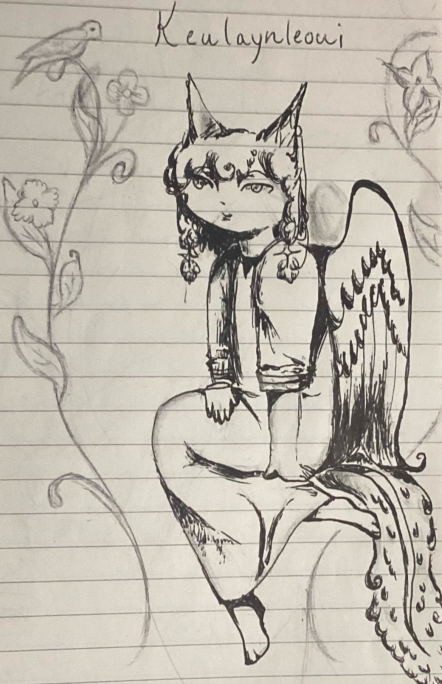
A chibi-er verison of Kuelaynleoui
When he had the words to describe his origin, Kuelaynleoui spread the story of Lynux's creation of the Itkyfs among them, and he was revered for, “All he’d done for them.” This is when he started thinking about what to do with his opportunities; he remembered his goal to dethrone God which he had failed to do. The second best thing to that was ruling over the people. After Lynux's exile from divinity and godhood, he felt intense and debilitating inferiority, after taking up a mortal body that could feel. This would bring him that sense of authority, superiority, and control over both himself, the inferior version of himself he hates, and his society and people. He would never fail again. And after a long while of proving himself capable of managing the people through … managing them, and their newfound unceasing reverence, they made him sovereign of their society.
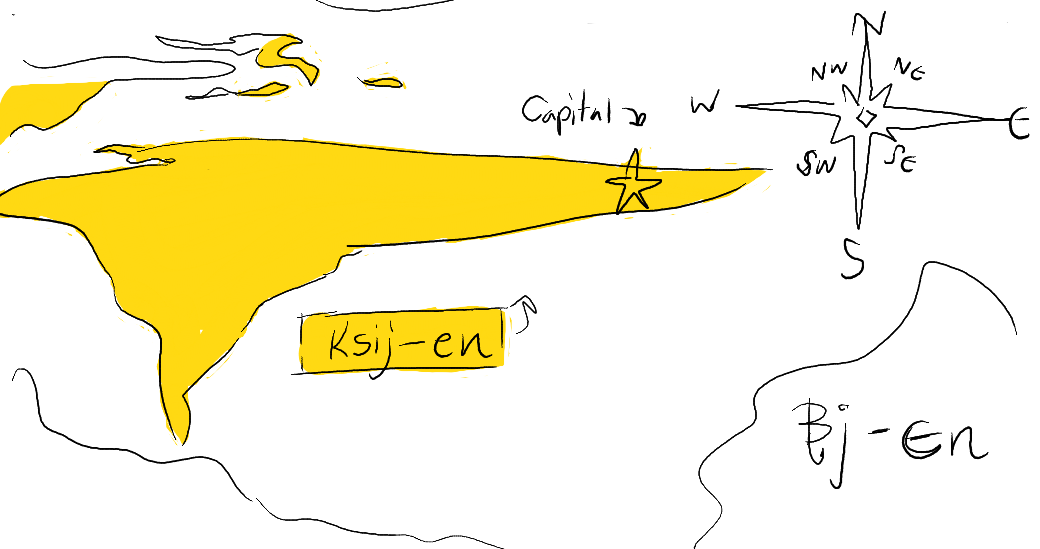
Following his coronation, he would slowly build up the trading affairs for the group of Iktyfs, provide a stable economy and government, and claimed territory over as much of the continent as he could. This continent was named, 'Ksij-En' . In Iktjkis, the word "Ksij" means God, which is also used as a pronoun and name for him aside from Lynux, which you are not allowed to call him (for reasons explained more in-depth in his profile.) The word that comes after Ksij, "En", means continent. So basically, this group of Iktyfs evolved into a strong, heavily-populated continent-country named Ksij-En, or "God('s) Continent."
Also: Iktyfs, at least in Ksij-En, don't have last names. They're differentiated with either a symbol in their signature saying which region they're from, or changing the spelling of their name/signature if they know someone has the same name as them.
Lynux didn't forget about Kuelaynleoui. He never did. He gave them a good position in government near to his, and was grateful for their assistance in his rise to power. Kuelaynleoui didn't take this well. One day, in the warm corridors of the Palace, which was then still under construction, they berated him, "Am I just a means to an end for you?"
Lynux was suprised. Why were they questioning him all of a sudden? This wasn't how they were supposed to respond.
Kuelaynleoui broke from his palace and their significant job, despite being away from the person they practically raised hurting them on the inside. They felt so attached to Lynux, it was hard to go. Kuelaynleoui also had a hard time believing in him as a God after seeing how he was before he rose to power as The Sovereign God: fragile and paranoid. He never made it clear, but they could see the undertones of those traits in him. They spread the news of Lynux's creation of Iktyfs to make him happier, to make him feel better, because they noticed his affinity toward leadership. They cared about people, they cared about him, and they wanted him to come to realize his full potential.
Years later, Lynux was informed that Kuelaynleoui had passed away from old age. He asked his informants to bring them to him.
He was brought Kuelaynleoui's body. He stared at it -- He wondered how much longer they would have obeyed him anyway. They could have tested his loyalty, or questioned him further, if allowed in Ksij-En's government any longer. He would have had to kill them anyway, since it would have come to that point eventually. It could've compromised his safety and security. And it was already done; he had already become the peoples' Sovereign God, thanks to them. it couldn't have been helped.
But Lynux shed one strange tear over their lifeless body.
He felt it with the tip of his finger, and smudged it on his cheek.
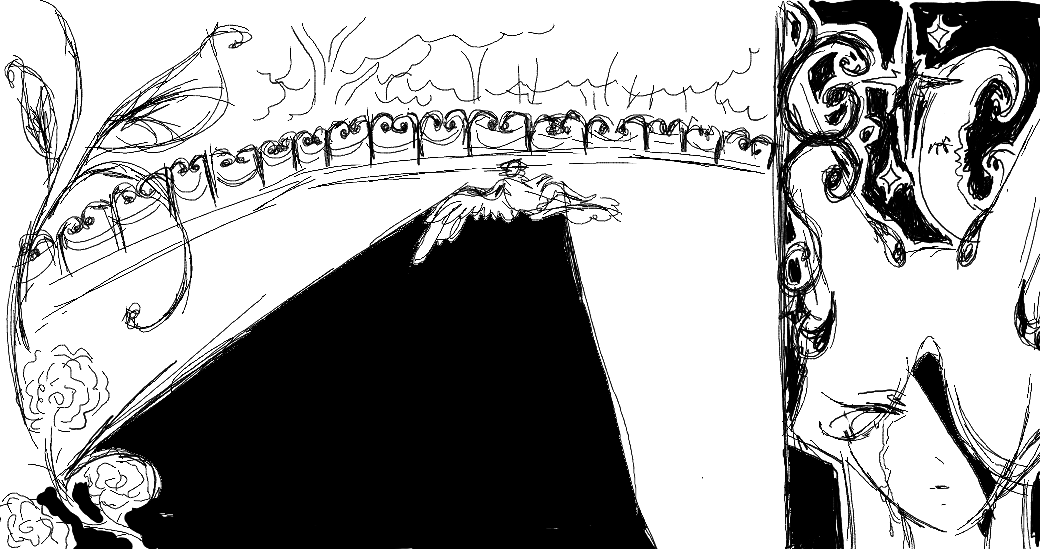
What became of Kuelaynleoui's memory to him is now faceless. He cannot remember what they wore, or what they looked like, apart from their kind personality. He would never understand why his body chose to react that way. He moved on easily, but they would stick in his memory.
* * *
Another one of reasons he was revered is from the power he granted the people. After Lynux created the people and became a mortal, he still had some excess powers left from God, since he didn't use it all up. He used this remaining power to further the peoples' belief in him through promising that, someone's first wish upon a star, it would be granted to the wisher, within the bounds of ascertainable reality, of course. (e.g. if you wish to be king, that may not be possible, so you would rise through the ranks in your job.) The time period at which your wish could be granted was subjective, and could've happened at any time in your life. It would only happen once, and you were advised to use this blessing very wisely.
Many people were upset that the blessings weren't guaranteed to be what they really wished for. One person in particular was very upset, and a couple hundred years after Kuelaynleui's death, on one bright summer day in the warm climate of Ksij-En, inside the open entrance of Lynux's palace, he was stabbed from behind. Bright, crimson red stained his white, flowing dress, and it splattered all along the floor. Luckily, the assassin was restrained by his guards & willing believers, and Lynux's wounds were carefully cleaned and healed by his caretakers.
But Lynux was not going to take any more chances. To go back to his inferior and fearful self was to lose to God again. To be Lynux, the refugee , and not The Sovereign God of Ksij-En, was not an OPTION for him.
One of the most important events in the history of Ksij-En happened after this assassination. Lynux walked out onto the palace's elevated podium, in front of all the people of his kingdom. A storm was coming. Despite the danger, and the concern expressed by his people, he kept speaking. When the storm was above Lynux, as he was speaking, he was hit by a strike of lightning. The thunder roared out into the crowd of people, shock spreading across them like a tidal wave. He collapsed, and died. His ‘last words’ were, "I will return.”
But he didn't die. He used up all of his remaining power to fake his death in a grandeur performance, and with that, the blessings to the people became null. People were wondering what to do with themselves now that God was "dead", and all of their hope and wishes were gone in turn. But nobody forgot what he said. That he'd return.
In his Palace, Lynux set up "Royals" to pretend to rule the country. They're basically a fake monarchy paid to do nothing and pretend to be important. However, when Lynux needs to make an important announcement to his kingdom, he will tell them to announce his speech in front of everyone in the kingdom. The Royals are aware of a higher power, but they don't know who it is, and some are at the least grateful for their privileges. That hasn't stopped some curious souls from trying to find out, but it hasn't resulted in anything meaningful or true ... The presence of the Royals also assures he won't die, since any assassination will go to them instead of him.
The kingdom is considered a sacrosanct spot because it's where he "died" and religious people tend to gather there (so if someone was born there, they are probably religious.) The religion continues to spread because of the abundance of trade within the country, as well as an internationally significant trade harbor being on the coast of the capital. It's a wealthy place and has exports of high value. Lynux dislikes working with finances, but understands it well, being a necessity.
For a while, Lynux ruled Ksij-En in secret, governing them as their one and only leader.
For a while, it was just like this. And then, elsewhere on the planet of Ikta, a war began. An uprising; a coup. Keuks was a very strong country on the continent of Bj-En. Keuks-y and Ksij-En (which is both a country and a continent) were strong allies: Bj-En exported things like metals and raw materials to Ksij-En, while Ksij-En exported things like tobacco and spices to Keuks-y.
This was how it had always been, however, in 17(whatever), Keuk’s monarchial government was challenged and overthrown by a group of citizens that called themselves Oulun, which, in their language, means something like “Revolutionists”. Eventually, The government of Keuks and the Oulun made a compromise: that Oulun would become a country elsewhere, and Keuks would stay as it had always been. The Oulun were generally not happy with this response, but they took the offer anyway, allowing anyone else who wanted to leave to come at any time. Only one neighboring country allowed them to take some land to use for their country, and that was Reui-y, but even after making the deal, many Reui-y people were not happy with their land being taken so easily. The conflict got to a point where some people were expecting a war between Reui-y and the Oulun. But only time could tell.
One preacher living in the eastern capital of Ksij-En heard of this conflict: Ikfinsj. (Pronounced eek-feens,) Ikfinsj is the bearer of a long line of an upper middle-class priesthood, who, at the time of the Keuks-Oulun war, was about (age here.) Ikfinsj likes presenting for an audience, and is very sociable. People find them outwardly easy to talk to and they have a lot of acquaintances, as can be seen by their countless Kiska (ornaments on an Iktyf's ears that display their various relationships' and friendships' status, most heavily practiced by easterners in the capital.) The only downside to being so sociable with the others is that Ikfinsj finds their relationships are only surface-level. They never really have had deep friendships, and as a child, years and years before the Keuks-y people had thought of rebelling, they were ridiculed, as well as heavily avoided, for their over-the-top personality, and too, feared for the strange face they made when they got too excited. They found refuge in religion, and as they took on the role of their pedigree as a preacher, learned how to be more professional and tone down their personality. But with someone they truly like, and have a real connection with, they would have the same excitement as the child they were forced to suppress. However they’re an older adult now, and they have responsibilities; time passed before they were ready, and they now resorted to find their only refuge in both religion, as well as their family, and the congregants they live with.
Usually, Ikfinsj preached about His Sovereign God (Lynux) at the church they both worked and lived at (they also lived with fellow religious congregants and family, it's like a dormitory and a church in one), and was a very popular priest at that. But after hearing this, and thinking over it, they had a stark realization, and in them the most maddening urge to say something of defiance to the ‘Royals’, and put their public speaking skills to more use. They were no stranger to expressing their opinions bluntly, so they took to writing that whole night.
The next day, they took up a podium outside the church, and spoke for hours on end. Ikfinsj argued that the focus they should have at the moment wasn’t preventing conflict between the people of Reui-y and the Oulun, but instead to see the issues the Oulun had with the Keuks-y government in the first place.
Notably, the Oulun, after regressing from Keuks-y into their own country, formed a democratic government. The Oulun’s issues with the government of Keuks-y was that it was authoritarian, which prevented the citizens from making their own decisions regarding their own way of life. Ikfinsj made a comparison between Keuks-y and Ksij-En, being that they were ruled by an almost identical system of government, but nobody took to regressing from the country or forming an uprising, as did the Oulun.
Many people in Ksij-En were shocked at this comparison. Life was better in Ksij-En compared to the much more povertized Keuks-y, which had gotten that way in the first place through trying to rise itself in the ranks, using technology to get an upper hand in the world. But the expenses meant they had to take more and more money, as well as to tax their citizens, in order to do so. Ikfinsj said that this exact thing could also happen to them if they did not speak up and prevent it, and that they might have not even seen the signs the Oulun people saw.
(Now, Ikfinsj themself hadn’t realized the fault in their own morals whatsoever. If complete autocracy was wrong, then worshipping Lynux, who had been publicly known to be a Sovereign, autocratic ruler hundreds of years ago, would be strictly contradictory. But they failed to see their own irony.)
Many people heavily disagreed with Ikfinsj, as, the ‘Royals’ (Lynux) had done many great, wonderful things for both Ksij-En and other countries: saving an entire nation from being wiped out by allying with them, providing food to povertious countries, etc. But some people also started agreeing with Ikfinsj, counterarguing that Ksij-En had also led certain countries to collapse, nearly got destroyed by another country due to a terrible, selfish decision, and etc., as well. Ikfinsj’s popularity slowly rose the more they decided to speak up about it, which caught the attention… of Lynux.
Lynux himself immensely disagreed with Ikfinsj, as Keuks-y was Ksij-En’s most valuable trade partner. Therefore, cutting off that goldmine of profit would ruin the economy of Ksij-En permanently. Lynux would also ruin his good relationship with the ruler of Keuks-y as well, Ebibq, which could possibly start a war between their countries. And most notably, he was Sovereign, so no way on Ikta would he ever allow them to overturn him, nor especially threaten to crumble his stability.
But Ikfinsj’s vigor and passion in the subject they talked about still caught his eye. At the time, Lynux was also trying to make a secret deal with Keuks-y regarding the situation, and Ikfinsj could easily rile up his people to distract them from what he needed to do in private.
So, one day-- a fateful day-- Ikfinsj got a letter at the front of the church doors. They picked it up, and found it was addressed from the Royals. Not exactly surprised-- as it was mere days after their speeches began-- but still extremely shocked, they grabbed it and quickly ran inside, jumping down at the nearest dining table, and ripping the envelope to read it. It said,
“Dear Ikfinsj,
I am too lazy to write this whole letter”
Ikfinsj took a minute to process this. For one, it would guarantee them more money, but it would be hypocritical to their previous speches.
Ikfinsj eventually decided to directly oppose the Royals, and in turn, the Ksij-En government. But first they wanted to see what it was all about, and try to get a grasp of what the Royals were doing. So Ikfinsj and "The Royals" (Lynux) exchanged letters back-and-forth for a couple weeks.
As they kept exchanging letters, the "Royals" supervising the planned polemics made a mistake: They had accidentally used the Iktjkis pronoun "Kajij" when reffering to themself, which was an immediate red flag, because only God was referred to by Kajij. Ikfinsj obviously questioned them about this, and the "Royals" decided to passive-aggressively, vaguely tease them about it, in a slightly confirming connotation of, "I may not be who you think I am, but I'm not going to tell you, because I think this is entertaining." Ikfinsj was dumbfounded, and from then on obsessively wrote to them, trying to figure out who it was-- at the cost of late nights and a messy room. Some congregants would say they only saw Ikfinsj during their usual sermons, as well as unusually sudden political speeches, but not once did they leave their room to do anything in their free time around others anymore, and they took dinner to their room night after night. The church members got worried. blah blah blah how did ikfinsj react. how did they find out
Lokus is the treasurer, and/or financier, of the Allegiance. Their actual name is Iko. They were given the name Lokus by Lynux to exert influence onto them, and to create a sustainable alias upon joining the Allegiance, lest any complications occur that expose their identity to the public. They were a high performer in mathematics as a child, and lived in a small, more rural northern area with their parents, until they were requested to live and work in the eastern city capital of Ksij-En… to join the Allegiance. They were the first to be drafted into the Allegiance, joining at about 24 years old. Lokus was never really that religious, but they at least believed Lynux was really God. Lokus was raised around good influences, such as their parents, and has a nice and passive personality; they try to compliment & care for others as much as possible, and try not to let their strong & negative emotions get out at all costs. They were taught to speak their mind when necessary, which goes against their ideals a little bit ("Will this harm our relationship if I talk about it? Would that make me a bad person?") so they have to shut their mind out when they truly know it's necessary to speak up about something. They also tend to hold grudges, even if they don’t like it when they do, and intensely judge others for not knowing about hyper-specific social cues they pick up on -- they don’t say this out loud though. They’re also very attentive, and notice very miniscule details about other people. They also struggle to make decisions, big and small, but have gotten better at making big decisions since joining the Allegiance. They’re physically very fit, and good at physical labor, due to being raised on a farm. They also play a few string instruments, and their favourite food is their parents’ cooking.
(When them and Lynux were the only people in the Allegiance, they would often have deep conversations together. Because of this, the other members of the Allegiance tend to notice a slight connection that goes a little bit deeper than surface level acquaintances.)
処刑
処刑
At this time, Lynux had been going on strange escapades outside of the Palace for months. When Lokus started to notice, they quickly grew suspicious of Lynux, and started to wait for him to leave to see what he was up to. It wasn’t long when Lokus was following them, that he took notice, and they were ordered to go back to their room.
After seeing this, Lynux decided that he needed to test Lokus's loyalty to the Allegiance. If he was really going to have them in the organization, they would need to be willing to lay their life down for Him. Their morals for him. If Lokus failed this test, they would be executed.
While Lynux is looking for ideas on how to test them, Lokus is allowed an outing (that is, to leave the Palace for a short, allowed amount of time), such a thing being rare, and part of the Allegiance’s rules, restricting contact with the outside world, with the exception of a couple days out of the year. And Lokus visits their parents. Lynux quickly realizes how suspicious this is, thinking they could be telling their parents about the Allegiance, and him secretly being God. This would be unacceptable, and more disloyal than he had thought previously. He had an idea.
He had to stop this from happening.
It was a bright, sunny day. The kind where you can feel the humidity, but you don’t really mind. There was a slight breeze, too, making it much more gentle.
Lokus and their parents were sitting in the living room, playing board games, and truthfully, trying to inadvertently (and innocently) discuss Lokus's job.
There came a few gentle knocks on the door, quiet rests between each one. Lokus answered the door.
At the sight of him, Lokus quickly withdrew themselves from the door, politely and deeply bowing. Lokus’s parents sat behind them, but quickly stood. At first, they didn’t recognize him. But soon enough they did.
One of their parents were shocked, and the other was instantly delighted. He was greeted very warmly, prayers from Lokus’s parents filling the room. They held his hands kindly, making conversation and offering gifts. He returned their friendliness.
Then their parents had gone off to get something for him..
Suddenly Lynux turned to Lokus and put his sword up to their neck, telling them that they have two choices.
Either kill their parents, and be let off,
Or save them, and let everyone on Ikta die at his will.
He pulled a second sword out of its sheath in the holster around his waist, and handed it to Lokus. No more words were said by either of them. Lokus slowly raised their hand to take the sword from him, not daring to look up into his face.
Lynux held them there for a while as they waited for their parents to return. It was a long, long, long wait... agonizingly quiet. Lokus was disturbed by the sound of his breath. He was real, breathing and living, and thought about doing this exact thing. Where was Lokus when he thought about it? The sun was beginning to set. They wanted to think smartly about the situation, but their mind was too fast to catch. This was IMPORTANT, they thought, but they felt nothing but the sunset's warmth on their fur. Weren't they scared? Maybe they could just stare into space now and it would all go away. That's something Luns would do. When Lokus's parents' returned, Lokus felt their heart one of them was eager to defend their child, and the other cowering, trying to get the other to calm donw. Lokus looked up at them like a begging dog, shaking in their legs, in their arms; in their hands, all of which held their final choice. For a long while, they all sat in silence. Lynux’s sword was shaking against their neck still, and they themselves were looking down at their own sword, deep in thought.
(It's important I say that Lynux does not have his divine powers after faking his death, and killing everyone on earth would not be possible. He's bluffing here; if Lokus chose to not kill their parents, he would've just shot them and their parents to death and moved on.)
Finally, one of Lokus’s parents spoke. Voice faintly shivering; “Iko,” they said, stepping forward, legs shaking, holding Lokus’s face. They grabbed their parent’s hands and moved them off gently, not daring to look into either of their eyes.
For a long time, nobody spoke. All three of them were looking at Lokus.
But they all, really, understood why they were sitting still. God himself was ordering this from them. Who would say no? It would be his will, it would be the fate of all that he saw, surely, that compelled him to coerce Lokus.
Finally, after a silence that seemed it would last forever, Lokus moved their hands to the grip, the other taking the pommel, and they dragged their feet across the floor toward one of their parents. They tried to reach out for their parents as one last embrace, but Lynux’s sword was increasingly sharpening against their neck. They faltered from it, and raised their sword high above them with both hands
Lynux stood motionless and blank, waiting.
Both times; both parents. They wept. They wept and wept and wept and all while they threw their weight into the sword, and all Lokus saw was an orange-red on the glimpses they took with their eyes held tightly shut-- they tasted the metallic feeling of blood that came when they opened their mouth-- they heard screaming, unclear to them even in the moment whether it was them or whether it was their parents.
It didn't feel like it ever ended. Lokus felt the smothered, dried blood on their legs, but didn’t look at themself. Not just out of shame but out of exhaustion. They could barely see anyway, from the tears that clouded their vision. They dropped the sword, and it clattered quietly. They slowly looked down at what was their parents, like a disgusting collage, and fell to their knees on the floor in desperate wails and gasps for air. It was all over. It was all over .
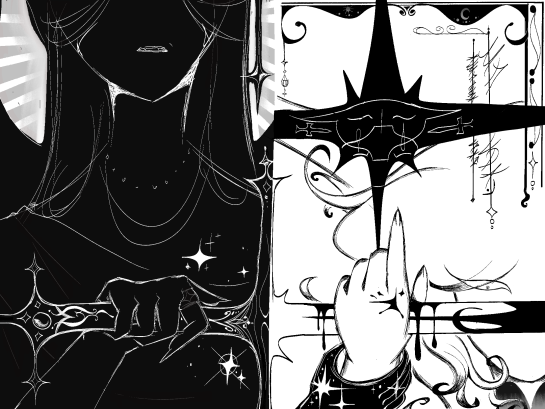
Lynux on the left, holding his sword by the hilt towards Lokus on the right, who is being coerced to grab the sword by the blade from Lynux's hand, and bleeds from it. Lokus is only looking at the blood they shed, not towards who's hurt or who coerced them. The sword is also simpler on the right, because Lynux is more familiar with both his own sword and weaponry in general, while Lokus is not.
Lynux stood quietly, listening to them, and waited. He sheathed his sword, then gathered the one Lokus had dropped, sheathing that one in his holster too. For a while, the only noise Lynux could hear was from that of Lokus.
When they were fairly quiet again, Lynux could hear birds chirping in the evening warmth, and the gentle sway of rye stalks, tobacco plants, and wheat. He walked over to them, crouching down and holding them by the shoulder, suggesting they head back. Lokus said nothing, wiping tears and snot from their face, what used to be full cries now pitiful chirps. They dared not open their eyes then.
He stood back up, and waited for Lokus to stand too.
When they did, Lokus walked drunken and dazed. They both came outside, no other people in sight in the rural farmland, and they both flew back to the Palace. A few times, Lokus almost fell out of the sky, but Lynux quickly assisted them.
When they returned to the Palace, Lokus headed for their room. They didn’t bother to shower.
Lokus doesn’t believe in a god anymore.
..After this incident, none of Lokus’s other relatives stepped up to continue the farm’s ownership, and they themself were occupied with their current job at the Allegiance, so the land was sold to be made business property. Lokus felt grief at this news, of their memories and childhood home. But they knew they had to move on.
Lokus is traumatized by this and in shambles after this. They can't leave this place. They have no immediate friends or family left. Lynux tells them something like,"Hey so... this is why you had to do that, I'm really sorry do you want like a hug or something I'll do whatever it takes to make you feel better" obviously bullshitting but Lokus doesn't realize and since they have nowhere and noone else to go to (besides Luns, which they werent really close with at all at this time) they confide in them. Lokus has so much anger in them from this incident (mainly directed at Lynux) that they're simultaneously trying to justify what he coerced them into doing, and also fighting that idea. It's mental dissonance to them, and doesn't help with the anger they have to fight back to stay calm around others at times.
Lokus develops a greater taste for alchohol for the first time around this period. And so does Luns, because they can't handle the extreme guilt and remorse of killing other people, like Lokus. They attempt to emotionally reserve themselves intentionally to try and disconnect from the guilt and believe its right, in the name of god and everything ... but they find themselves disconnecting from their religion, and not feeling the protection of Lynux/God like they used to; not feeling the comfort or the warmth from it anymore and feeling exposed to the effects of their family and the danger of other people and even Lynux.. This startles them once they realize, and the guilt becomes overwhelming. They risk the chance, spilling their feelings to Lokus one afternoon in Lokus's room. From that point on, Lokus tries to help Luns through everything. It takes a while for Luns to get comfortable telling Lokus everything, but they start to equally confide in each other more over time, Lokus talking through things as well. Things aren't easy, and sometimes talking through things leads to conflicts between them. But they have nowhere else to go, so it usually ends up resolving. From Lokus, Luns learned what it was like to have someone actually care for someone in a deeper way than a fleeting friendship, and how to work out what they were feeling. From Luns, Lokus learned what it was like to know someone with a vastly different life and perspective than them, and how to help others in genuine, meaningful ways. Lynux gets suspicious of their absence during some nights, and Luns grows to despise their job over time.
how did they reccomend luns when hearing about lynux's idea and needing another member introduce lunsAs they kept exchanging letters, the "current ruler" supervising the speeches made a mistake: They had accidentally used the Iktjkis's (their language) pronoun "Kajij" when reffering to themself, which was an immediate red flag, because only God was referred to by Kajij. Ikfinsj obviously questioned them about this, and the "ruler" revealed that they weren't the ruler of the country, but someone with high political power (secretly Lynux.) Ikfinsj was dumbfounded, and from then on obsessively wrote to them, trying to figure out who it was at the cost of late nights and a messy room. Some congregants would say they only saw Ikfinsj during their usual sermons, as well as unusually sudden political speeches, but not once did they leave their room to do anything in their free time around others anymore, and they took dinner to their room night after night. The church members got worried.
Ikfinsj enjoyed the challenge, as much as they agonized over every detail. Lynux, too, enjoyed it thoroughly, and went out of his way many, many times to tease Ikfinsj in their letters. One day, Lynux made one decision that would change their relationship forever, just to see what Ikfinsj would do-- at exactly 2:00 am on a rainy night, they would both meet in the empty church, and Lynux would finally tell Ikfinsj it was him. And they did ... Ikfinsj was left in a state of shock, and at first did not believe that he was actually the person behind the letters, nonetheless ruler of Ksij-en, nonetheless God-- but it was true. God was not dead, and he was Sovereign. But why would Lynux tell Ikfinsj this, and sacrifice everything that his greatest motivating fear pushed him to hide and even kill for?
When Ikfinsj learned that Lynux was Sovereign, they quickly pieced together that the unnamed organization with communication restrictions was under his jurisdiction. This came with their discovery of several backended political moves by Lynux (of which Lynux never expected to be discovered) that they did not ^
Lynux saw something in Ikfinsj. Something was very special about them, the way that they didn't completely revere him, but rather challenged him in their devotedness. They questioned him. And Lynux felt such an intense adrenaline that he very much liked, just by interacting and being around them... He felt, indeed, that he could go down to Ikfinsj's level and stand up again just fine. It felt like, for the first time in thousands of years, he had an equal match on Ikta. Perhaps it's the crazy things people do in the blurred frenzy of obsession and infatuation that contradict everything they've ever done. It's in Ikfinsj that Lynux finds the only emotions he allows himself to feel. Since Keulaynloeeuje's demise, he has made sure he feels nothing that would interfere with objective work. But Ikfinsj is Lynux's modern Keulaynloeeuje and more. Ikfinsj is everything Lynux could ever want in an acquaintance, but they began to tilt past a bit more than acquaintances, even past friends. Ikfinsj is a highly regarded priest who has a family history of priesthood. They took this role and were better at it than anyone expected; with exceptional public speaking skills, and the high standards of the public, they do quite well, even if there is some outrage against what they say now and then ... Lynux contacted Inaljn through a letter disguised as "The Lord's Closest" (see prev.) and accidentally slips past this persona, to which Ikfinsj asks about it, Lynux teasingly doesn't deny he is who he is, and Inaljn wants proof that he could actually be God. Lynux and Inaljn develop a passive aggressive rivalry (Lynux telling Inaljn what to say in speeches, Ikfinsj slightly hinting at a contradiction in the speech as his part in the rivalry, and so on ...) and Ikfinsj now has an idea to prove if this is true or not. And so, as the years went by, Ikfinsj reccomended Filyn (later named Luns by Lynux) to Lynux, since Filyn was a member of the church they were in Ikfinsj wished he could see what happened to Filyn after reccomending them. After Lokus joined the allegience, Lynux considered this and sent a letter to Luns.
.png)
^ Ikfinsj (left) and Lynux (right), Ikfinsj is presenting incense (a valued import to Ksij-en from their commercial ally Bj-en) to him as a religious offering; Lynux is reaching out to the both the incense and Ikfinsj themselves, getting down to Ikfinsj's level in a vulnerable manner.
Luns was very religious, growing up in a household centered around religion, and it was engrained in them from a young age. They went to the church with their parents for a few years until their parents left them to be raised in the Northern Church by its inhabitants; their parents justifying themselves with a prophecy they claimed to have both seen in their dreams. There, they were fed and raised by the congregants, later working as a part-time librarian for many years, reading books, bird watching and writing a lot of poetry. They published their works to the response of a small, dedicated fanbase who found them very talented. They grew up notably alongside Ikfinsj, a young worshipper only a few years older than them who came from a long lineage of priests. They looked up to Ikfinsj, learning how to practice faith by doing what they did-- unfortunately, Luns and Ikfinsj had opposing personalities: Luns being introverted, straightforward and book-smart, and Ikfinsj being sociable, gregarious and charismatic. Thus, they never really became proper friends, since Luns found them a bit obnoxious. Ikfinsj enjoyed their company, but realized this, and didn't bother socializing with them much, however still praising Luns for their smarts upfront & elsewhere. Them praising Luns would lead to Luns being invited to the Allegience; since Ikfinsj knew the Sovereign Lynux (why and how so explained in the story summary) they suggested Luns as an excellent writer to Lynux, who was looking for a talented one for an important government job, and also explained that they'd been involved in some sort of prophetic dream by account of their parents. Lynux concluded they were fit for the job, and Luns was drafted into the allegience as the writer for goverment publications. Luns's writings became more popular after they announced they had to retire publishing personal works (due to Lynux's orders.)They were nicknamed Luns by Lynux to enforce his authority, their actual name is Filyn.
.png)
^ Luns
At being drafted into the Allegience, Luns was completely awe-some of Lynux before them. They were extremely obedient and praiseful, glad to be even in the same palace as him, following his every order. The Palace itself was also something extraordinary to them, being more regal than any building they'd ever been in, even growing up in the rich Northern region, home to the capital of the country (Ksij-en) and the grand Palace itself. It would continue like this for a few years, until Luns began to get to know Lokus. They always felt something that drew them to Lokus ever since joining the Allegience, and didn't know what it was until they started talking. Luns realized over time that they were falling in love with Lokus, and after many embarrassing moments and an unexpected reciprocation, later the two became spouses.
At one point, after the decade+ that Luns and Locus have spent in the allegience (they are now in their early 30s, were drafted in their early 20s) Locus decides to tell Luns about their idea to kill Lynux. Before confiding in Locus, Luns sometimes they had no option but to confide in Lynux, making them sympathize subconciously at times; Luns partly feels like it would be a mistake to get rid of Lynux because of their competency. This makes Luns aversed to the idea at first, but their growing spite for their job and the gradual dissolve of their devoutly religious lens through which they viewed life, they eventually told Locus they could do what they wanted, not outright saying, "Sure, I would love to kill god!" because it would feel awful and violent. Locus has grown more accustomed to the violence over time, but Luns has grown more disgusted towards it over time.
Lynux has a very deep oath to keep this kingdom/nation standing for ambiguous reasons. It's partly selfish, thinking he deserves to be the rightful ruler of it and will do anything to keep his position (and I mean anything, as you'll see) and ensuring loyalties regularly, trying to make sure this kindgom wont fall apart like his divinity did from one mistake. (He is not extremely perfect at this, to note ... He just covers his tracks very well when things go south.) He keeps himself justified by having the sentiment that he's doing this for everyone in the kingdom, however slightly knowing it's not the case, and not caring. He mostly tries to ignore any emotion that came with mortality, and wants to return to godhood where he didn't have such a thing. He tries to force the Alleiance to trust him, to not seem like a threat, through making friends with them, having good conversations with them, and occasionally being funny with them. He is physically feeble, but has a strong suit with weapons and the like.
(From here on out, the story is relatively unclear and is still subject to change :) )
It's important I note that the following sentence has mentions of "everyone" and "someone" which is referring to the allegience, and I refer to them this way because I plan to have more characters in the allegience besides Luns and Locus in the future. If this is the case and more members are made, that means Luns and Locus spread the message to the others.
This all coalesces eventually to everyone in Adsum Absconditus setting up the planned murder of God. They are sick of the atrocities and decide to end the cause of everything. They don't know what he's capable of (not knowing he's mortal) and Lynux catches on to a little bit of this plan, but doesn't end up figuring it out due to a heavy workload he already has. Locus says they want to talk with them about something privately. In the room, they talk, and Locus finally does lecture them about how they feel. Lynux responds by threatening Locus and injuring them with a weapon from the holster under his gown (since they were extremely suspicious before even entering), but is stopped by someone before they could do anything serious. Everyone in the allegiance comes out of hiding armed, and in order to prevent Lynux from getting away, they amputate his right wing with a sharp weapon. Everyone listed their grievances with him, and he made it clear he had no intention to change the way things were, since his methods were ideal to him.
They take him, in pain, out to the large podium in front of the Palace, and ask all citizens of the kingdom to gather. (It’s also worth noting that people in high positions of power have special insignias for their roles. For the allegiance, they have the highest ranking insignia, so they are respected the moment this insignia is seen without regard for past impressions.) Luns is the one who announces everything he’s done and everything that he was behind to the public. They let Lynux speak for himself and threaten to shoot if he lies, to which he tries to bend the rule by not lying about things everyone knows, but covering up the truth that everyone else doesn't know, and justifying himself because, "He was doing it to keep the keep the kingdom from collapsing." He also calls the allegience membres by their real names for the first time as they decide his fate. This makes it harder for the members to kill them.
And this is where the story can take two routes depending on my decision of how this story ends. In one end, they successfully kill Lynux and the kingdom is left in a state of confusion on what to do next, who to rule the kingdom, if financial situations will change, etc. Now, I'm not aversed to that route entirely, but it ends too quickly to make me satisfied. That being said, I'll describe what happens in the 2nd end because it'll probably be where I go with this.
Lynux ends up finding a weapon of some kind and taking back his authority over the others, threatening that they don't know what he can do since he is a god (he's lying, as I've mentioned, he can't actually do anything ...) something happens and the kingdom enthusiastically accepts him back as a ruler, making Lynux more vain than he already was, ignoring any past notion he had about possibly dying in a position of power. He becomes a bit more reckless now that he's not hidden anymore, and his conceit grows by the day.
And that's about all I have for now! Hopefully that made even a bit of sense, lol.
-----------------------------------------------------------------